
Visual inspection or dust wipe: which one does your town require?
 August 27, 2026
The method is set per municipality by the NJ DCA. Dust-wipe sampling is mandatory only where at least 3% of tested children six years of age or younger have a blood lead level of 5 µg/dL or higher; everywhere else the standard is a visual inspection, and the inspector may add dust wipes at their discretion. Hudson County municipalities confirmed so far are visual, per the DCA method list (PDF).
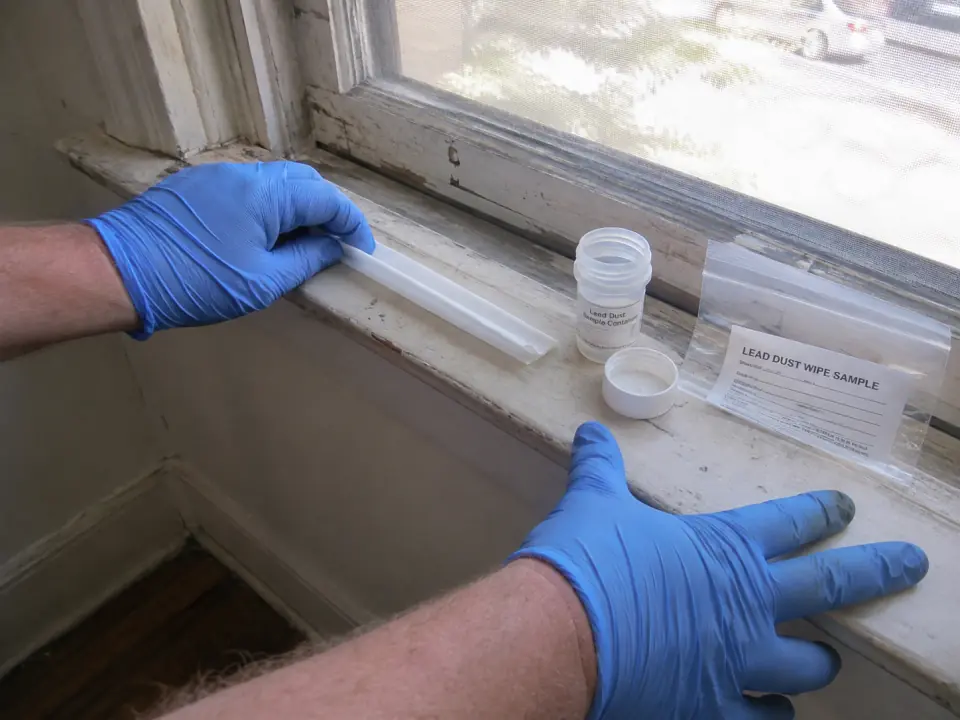
The two methods, side by side
| Visual inspection | Dust wipe sampling | |
|---|---|---|
| What it checks | Condition of painted surfaces (deterioration) | Lead dust on floors, sills, wells, sent to a lab |
| Time on site | 30–60 min per unit | Similar visit plus lab turnaround (days) |
| Cost | Lower | Higher: lab fees per sample |
| Where required | Most municipalities, incl. Hudson County towns confirmed so far | Municipalities with ≥3% elevated child blood lead |
| Pass result | Lead-safe certificate, 2 years | Lead-safe certificate, 2 years |
When dust wipes show up in a visual town anyway
Two cases. First, the inspector has discretion: visible dust conditions or a recent history of hazards can justify sampling. Second, after remediation work, dust-wipe clearance testing is how the fix gets verified before the unit is re-certified. Neither changes your town’s baseline method.
The numbers on a clearance report are federal rather than state. N.J.A.C. 5:28A sets no loadings of its own: it defines dust wipe sampling as a sample tested by a method approved by HUD (§ 5:28A-1.2) and repeats that instruction for the inspection itself (§ 5:28A-2.3(b)). Those federal levels dropped on January 12, 2026. Under 40 CFR 745.227 a surface now clears at below 5 µg/ft² on floors, 40 µg/ft² on interior window sills, and 100 µg/ft² in window troughs; anything at or above those loadings has to be recleaned and retested. The looser figures printed on older reports came from the standard EPA replaced in its 2024 rule.
Method questions
It measures a different thing. Visual finds deteriorated paint; dust wipes measure actual lead loading on surfaces. The DCA assigns the stricter method where children are already being exposed.
Yes. Some owners do it for extra assurance in units with young children. It adds lab cost and a few days.
No, and the two get mixed up often. New Jersey wrote its own threshold into the statute: a blood lead level of 5 µg/dL or higher in children six years of age or younger (N.J.S.A. 52:27D-437.16, repeated at N.J.A.C. 5:28A-2.3). The CDC blood lead reference value is a separate figure serving a separate purpose: CDC lowered it from 5 to 3.5 µg/dL in 2021 and calls it a population measure, not a health-based standard or a toxicity threshold. The DCA method list runs on the state number.
Check your row in the Hudson County requirements table; it tracks the DCA list.
Tell us the address; we confirm the method and book accordingly.