
Lead-safe vs. lead-free: which certificate should you get?
 August 27, 2026
Lead-safe: a visual pass, valid 2 years, the standard route. Lead-free: every painted surface tested with an XRF analyzer under N.J.A.C. 5:17-3.16(b); if the unit passes, it is permanently exempt from the law. Lead-free costs more upfront and many older units cannot pass it.
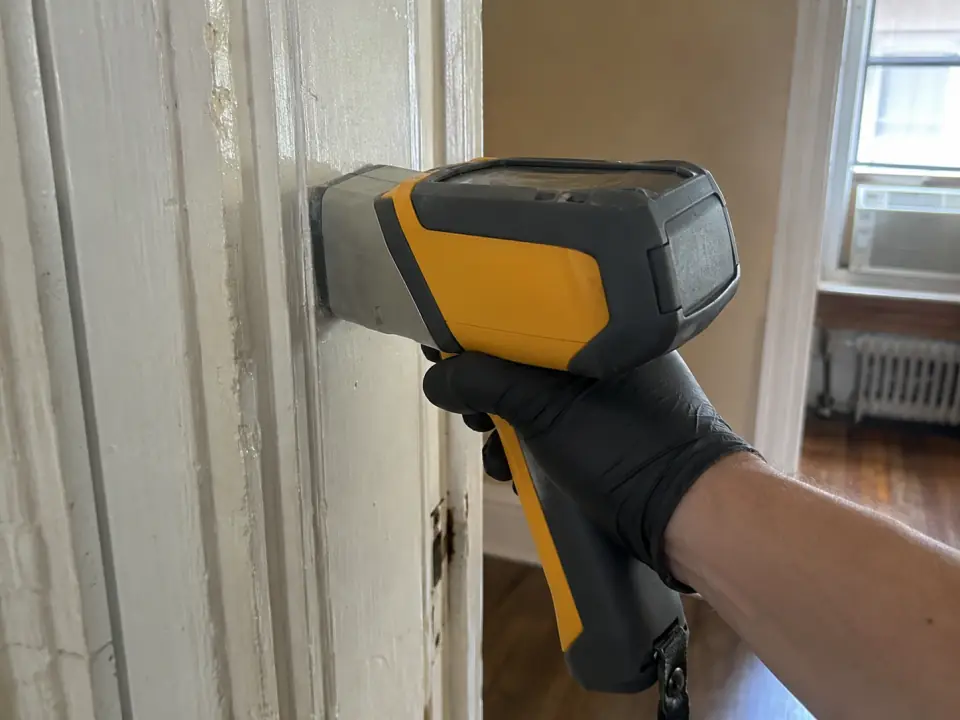
Side by side
| Lead-safe | Lead-free | |
|---|---|---|
| Method | Visual assessment of paint condition | XRF instrument reading on every painted surface |
| Validity | 2 years | Permanent; the unit exits the law |
| Cost | $150–200 typical single unit | Higher: per-surface instrument survey |
| Can an old unit pass? | Yes, if paint is intact | Only if old lead paint was actually removed or never present |
| Best for | Typical pre-1978 rentals with maintained paint | Gut renovations, post-1978 confirmations, long-hold portfolios |
The break-even logic
There is a second route to lead-free, and it starts from a failed inspection: if you remediate by full abatement and the local enforcing agency issues a lead abatement clearance certificate under N.J.A.C. 5:17, the lead-free certificate issued at that final clearance exempts the unit from future periodic inspections (N.J.A.C. 5:28A-2.5). Owners who are already paying for abatement should ask the contractor whether clearance can be documented that way.
Lead-safe repeats: every 2–3 years, forever, per unit. Lead-free is once. If you gut-renovated a unit down to the studs, the XRF survey will likely pass, and one test ends the inspection cycle permanently. On a 10-year hold, that is 3–5 avoided visual inspections per unit. If the unit still has original trim and windows under layers of old paint, it will almost certainly not pass XRF, and lead-safe is the only realistic route.
Certificate questions
Almost every New Jersey landlord needs the lead-safe certificate. It is a visual inspection, the certificate is valid two years, and it is what P.L. 2021, c.182 requires at tenant turnover or every three years. The lead-free certificate is optional and permanent, but it requires an XRF reading of every painted surface under N.J.A.C. 5:17-3.16(b), and a pre-1978 Hudson County unit with original trim will usually fail it. A single-unit lead-safe inspection runs $150–200 plus the $20 state fee; lead-free costs more because every surface is instrument-tested.
In New Jersey only a DCA-licensed lead evaluation contractor may run the XRF survey behind a lead-free certificate, using staff certified as lead inspectors or risk assessors. The instrument reading itself is defined by N.J.A.C. 5:17-3.16(b). It is the same licensing world as the lead-safe visual inspection, and the same contractor can usually do both.
No. A failed XRF survey in New Jersey leaves you with documentation of exactly which surfaces carry lead-based paint, which is what an abatement plan needs anyway. The unit stays on the ordinary lead-safe track: a visual inspection, a certificate valid two years, repeated at turnover or every three years under P.L. 2021, c.182.
Yes. A New Jersey lead-free certificate attaches to the dwelling unit rather than to the owner, so it survives a sale and permanently exempts that unit from the periodic inspections required by N.J.A.C. 5:28A-2.5. For renovated multifamily in Hudson County that is a genuine selling point, because the buyer inherits a unit that never re-enters the inspection cycle.
Describe the renovation; we will tell you if lead-free testing is worth pricing out.